Monday, December 22, 2014

Ina Coolbrith contemplates war on Christmas Eve 1863

Ina Coolbrith came to San Francisco at age 21 in the middle of the Civil War. On Christmas Eve 1863, she sat in her Russian Hill parlor as the rest of her family slept and the clock on the mantel kept time with her "midnight thought."

Ina was a Union girl, but that wasn't a given in California. One year earlier she had lived in Los Angeles where Union troops drilled in the streets to quell Confederate sympathizers. After she moved to San Francisco she showed allegiance to the Union by attending a festival organized by Thomas Starr King, the minister of the First Unitarian Church who was known as the orator who saved the nation.

Ina was reeling from a divorce she had obtained a year earlier after her husband tried to kill her with a six-shooter, but on this night her personal melancholia made way for a broader pathos. Here's the heart of her twenty-one stanza poem "Christmas Eve: 1863,” published in the Golden Era:


A thought of the gory trenches,
Dark-seaming our Country’s plain,
Where the forms of friend and foeman,
Rest—never to rise again!

Where the gold-tinted curls of boyhood,
Dark tresses of manhood’s prime,
And the silvery locks of the aged,
Commingle in dust and slime...

Each sabre that clashed in the carnage,
Each bullet that whizzed thro’ the air,
Hath sped to some desolate house-hold
A message of death and despair.

Yet we sing of the splendor of battle,
“The pomp and glory of war!”
Oh, God! Could those battle-fields open,
And show what their trophies are:

Could the thousands of maimed and mangled,
Of widowed and orphaned, be led
To the rivers, and hills and valleys,
That are drunk with the blood of their dead:

How quickly would rage melt to sorrow,
How silenced the cannon’s roar;
And the hands that are clenched in combat,
Be clasped in love, once more!

Fifty-two years later Ina Coolbrith was crowned California’s first poet laureate during the Panama Pacific International Exposition, an honor that made her the first state laureate in the nation.

Friday, October 31, 2014

Ina Coolbrith inducted into the CA Library Association Hall of Fame

Ina Coolbrith was California’s first poet laureate and Oakland’s first public librarian. She was inducted into the California Library Hall of Fame on Friday, November 7, 2014, during the CA Library Association’s gala at the Marriot Oakland City Center. I was proud to accept the award on Ina's behalf.

Learn more about the Hall of Fame and the 2014 inductees.

The following day, Saturday, November 8, 2014, I gave a talk about Coolbrith at the Oakland Public Library, Oakland History Room, at 2 p.m. I told attendees how John Muir, Jack London, Joaquin Miller, and Isadora Duncan spent time in the library, and explained why Coolbrith called the place her  “Inferno.”

Ina Coolbrith: The Bittersweet Song of California’s First Poet Laureate will be available in March 2015.


Wednesday, October 8, 2014

"View from the Blind" in Bay Nature magazine

I spent the last year learning about hunting and conservation, a long-standing tradition in North America that harkens back to the second half of the 19th century.

My story about hunters who are passionate about the natural world is in the October-December issue of Bay Nature magazine. 

Read it online.


Tuesday, November 5, 2013

"Okeanos: A Performance Where Dancers Move Like Octopuses and Seahorses," a blog post on Smithsonian.com

Photo by Joseph Seif
I loved working on this story because it brought together my love of dance and the ocean. While I wrote it I watched the video, "Naomi Underwater," by Joseph Seif over and over again. It is mesmerizing. Jodi Lomask, the artistic director of Capacitor, discovered a new technique she calls "sink and fall" to choreograph the video.

Go to "Okeanos: A Performance Where Dancers Move Like Octopuses and Seahorses" at Smithsonian.com

Friday, June 14, 2013

The House is Yours: Sarah Ruhl's Water

In Sarah Ruhl's script for Dear Elizabeth, she gives this stage direction for when Elizabeth Bishop and Robert Lowell meet in Maine:

Suddenly the stage is full of water and a rock.
They stand waist high in cold water, holding hands, looking out.
A silence.
She turns to him.


Photo courtesy of kevinberne.com
I love the simplicity of that direction, and that Ruhl didn't back away from her vision even though the actualization of it sounds untenable. She believed that the director, Les Waters, the scenic designer, Annie Smart, and the stage crew could bring her imagination to fruition.

The resulting water scene in Dear Elizabeth, now playing at Berkeley Rep, doesn't match her directions exactly, but it does interpret it.

I can't say more or I'll spoil the surprise. What I can tell you is that underneath the stage there are two 500-gallon water tanks and a sump pump to get the water up to the stage. It takes two people on headsets to run the tank. When stage manager Cynthia Cahill gives the cue, "Go water," one of the the crew flips the open switch on the first tank. When that primary tank gets low, the second crew member opens the valve of the "slave" tank. "The set-up is very Rube Goldberg," says stage supervisor Julie Englehorn.

At intermission, the crew pushes the water off the stage to a downstage drain with long-handled squeegees. They follow up with towels. After each performance, Englehorn washes four loads of laundry.

And what does the water mean? Literal-minded patrons want to know.

In one poem, Bishop wrote, "There are too many waterfalls here; the crowded streams / hurry too rapidly down to the sea." So there's that. I asked a poet what she thought the water meant, and she said, "emotional possibilities." Another poet looked at me quizzically, "Does it have to mean something?"

Come see the water, and this beautiful and tender play that Ruhl elegantly describes as, "a play in letters from Elizabeth Bishop to Robert Lowell and back again."

Learn more here.

The "House is Yours" is a specific term used by a front-of-house manager in handing over the audience to the stage manager. I'm a house manager at Berkeley Repertory Theatre, but please don't hold them responsible for anything in this post other than the fact that they employ me in their house built on words.

Wednesday, April 17, 2013

"An Artist Creates Fog in San Francisco," Smithsonian.com

Fujiko Nakaya is soft spoken. I could barely hear her during our interview outside of San Francisco's Exploratorium at Pier 15, especially with a fork lift beeping behind us nine days before the opening of the science museum and the debut of her latest fog sculpture, Fog Bridge.

I leaned in to what she had to say: "Observation is imagination."

Read more in "An Artist Creates Artificial Fog in San Francisco," at Smithsonian.com.

Saturday, September 15, 2012

The Face of Water

Craig Gilliland, "Fogbank LL"
 Oil on canvas, 6'x4'
Last year while out at sea with ACCESS, a research partnership between PRBO Conservation Science and our two local marine sanctuaries, Gulf of the Farallones and Cordell Bank, I had trouble concentrating on the story I was reporting because the surface of the water captured my attention and wouldn't let go.

A few days later I put a soundtrack to the feeling: 2Cellos play Cold Play's "Viva la Vida"

Painter Stephen Ehret, who has lived in an anchor-out boat on Richardson Bay since the early 1970s, has painted nothing but the "face" of water for over a decade. "Water is very emotional," he says. "It goes through different phases and repeats different faces everyday depending on the wind and sun."

Stephen Ehret, "Early Morning Rain"
Graphite & acrylic glazes on canvas, 6' x 8'
"I try to capture a certain moment of light on the water," he says. "This is one of the faces of water. It has a certain quality or gesture to it. It speaks somehow, has an emotion."

Ehret is one of the artists showing work in The BiggerPicture: 7 Artists Paint Large to Support Coast Cleanup, an art show at the Bay Model in Sausalito from September 12 to 29, 2012. The other artists are Chris Adessa, Jennifer Fearon, Craig Gilliland, Victoria Mimiaga, Thomas Wood, and Kay Young. For the show, the seven artists have painted large (at least 6 feet) to honor the beauty and mystery of the ocean, and to recognize the importance and challenge to keep it healthy. A portion of the sales will go to the San Francisco chapter of the Surfrider Foundation.

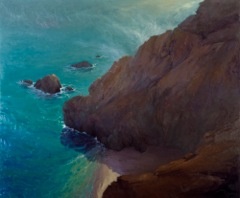
Chris Adessa, "Sheltered Beach"
Oil on canvas, 60" x 72"
Meet the Surfrider Foundation on September 22 from 1 to 2 p.m., and stay for a reception with the artists from 2 to 4 p.m.

Bay Model Visitors Center, Sausalito
Contact: info@thebiggerpictureartshow.org or (415) 302-1320