Monday, January 19, 2026

Paddling a Restored Marsh

Nice & dry before the spill.

Unexpected soakings can occassionally happen when paddling a canoe, but it usually doesn't occur when I'm reporting on a story!

It's a minor detail in an otherwise inspiring story about the artful restoration of Pacheco Marsh in Martinez, California.

Read my latest in Bay Nature magazine, celebrating its 25th year!


Mount Diablo from Pacheco Marsh. Photo by Aleta George


Saturday, November 1, 2025

Jack London's Boats

To commemorate the 150th anniversary of Jack London's birth on January 12, 1876, I wrote an article about the boats London sailed on San Francisco Bay for Latitude 38, a Bay Area-based sailing magazine that has been going strong since 1977.

Read my article here.

London, once one of the most popular writers in the world, had a formative, lifelong relationship with the Bay. But previous London biographers did not explore this vital bond, or how the Bay, and its multicultural maritime community, shaped Jack London.

Photo: Jack London on the waterfront, 1906 (detail). Jack London Photographs and Negatives, The Huntington Digital Library, The Huntington Library, San Marino, CA.

Wednesday, October 15, 2025

Walking in John Muir's footsteps at Alhambra Hills Open Space


A perk of being a journalist is to visit new places, and that's what I got to do
 when Bay Nature asked me to write about Alhambra Hills Open Space, a 297-acre preserve in Martinez that includes land once owned by John Muir.

I explored it twice, first with Kathy Briccetti, who has a keen eye for things, and again with Dave, who explored the trails with me while patiently waited as I took notes.

The things I like most about this open space are the views and the quiet. I also admire the people who saved it from being developed.

Monday, April 28, 2025

Serendipity and Writing Retreats


I write this from Kaneohe on the island of Oahu in Hawaii. The trade winds blow through windows that look out on the jagged Ko’olau Range. The desk at which I am working belongs to the grandson of a primary character in my biography about Jack London and his formative, lifelong relationship with San Francisco Bay. My host’s “grandpa” was Yoshimatsu Nakata, London’s longtime valet, first mate, and surrogate son.

I am on a two-month writing retreat. While this retreat is extra special, it is an example of the type of writing retreat I have given myself for years: When friends and family go on vacation, I retreat to their houses and write.

Most people associate writing retreats with residency programs. As an example, I launched my biography about Ina Coolbrith during a month-long residency at Blue Mountain Center in the Adirondacks, where I studied my subject and swam in the lake every day. As the leaves started to change color at the end of September, the mail carrier told me, “We don’t do that here.”

Residency programs are great but there is another way to give yourself the gift of concentrated writing, and that is the way that led me to Kaneohe. It’s simple, with no application or competition required. When friends and family go on a trip, I lug my materials to their homes in San Francisco, Berkeley, or Gilroy, California (or in this case, across the ocean to Oahu), and work without the distractions of home. Yes, I walk the dog, clean the kitty litterbox, and put the chickens in a coop at night, but these are minor chores compared to the rewards. Separation from your own living space results in concentrated writing time that can help you go deeper and make connections, get more work done, and form new habits. 

Here in Kaneohe, I have established a new routine. I go to bed early and wake up naturally before dawn. While the coffee is brewing, I shun my phone with its distracting emails and disturbing news. Instead, I do five sun salutations and read a poem. I got the poem idea from editor Susan Leon at the most recent Biography Lab. (I was here in Oahu during the Lab and that afternoon found a Poem a Day book in my host’s bathroom.) .

Serendipity can happen on a writing retreat. More than a decade ago, while working on a biography of the poet Ina Coolbrith, I was on a retreat at a friend’s house in Berkeley, California. One day on my routine lunchtime walk in the residential hills, I discovered a cluster of paths, stairways, and streets named after literary men I had been writing about that morning! Bret Harte, Charles Warren Stoddard, and Mark Twain were represented, but where was Ina? The byways were all named after men, most of whom had left California, whereas Ina had stayed and become California’s first poet laureate (and has recently been inducted into the 2025 CA Hall of Fame). To include her, I recited her poetry on subsequent walks.

Ina Coolbrith Circle's Richard Angilly and Claire Baker
(with me in the middle) help celebrate the new path in 2017.
When the book was finished, I gave a reading at a Berkeley bookstore and suggested that Harte give up one of his four byways. Several local groups heeded the call and changed the name of Bret Harte Lane to Ina Coolbrith Path and installed a handsome biography plaque at the bottom of the stairway.


Serendipity can happen, but poop also happens when there are dogs, cats, bunnies, and chickens involved. It is unlikely that you, like me, will get locked in a chicken coop at dusk without your phone for 30 minutes before discovering the string that sets you free, or that you will have a naughty beagle that growls at your host’s puppy at mealtime. You will, however, leave the dishes in the sink, cook when you feel like it, and remain un-showered for days to put your writing first.

My writing retreats usually last from five days to two weeks, so how is it that I get to stay at this comfortable and quiet home in Kaneohe for two whole months? I met my host by letter and then visited him and his wife in Kaneohe last year. They graciously showed me family photos and we paid our respect at Nakata’s grave (everyone called him Nakata, not Yoshimatsu). Back at home in California, I shared all my research about Nakata with his grandson. He was grateful because although as a boy he knew his grandpa, the two never talked about Nakata’s early years with London. After leaving London’s employ, Nakata became a dentist and lived a long and fruitful life in Honolulu. 

Last summer, my hosts visited Jack London State Park in Glen Ellen, California. I arranged for a docent to show them around and joined them. As we drove around the park in a bumpy golf cart, I mentioned my writing retreats. I wasn’t thinking about their home in Oahu, but they latched onto the idea. They wanted to travel and, as they are supportive of my project, the plan blossomed from there.

Today, my hosts are in India, and I am in Kaneohe. The wall behind the desk is covered with framed family photos. At top center is a photo of Nakata as a fit and healthy old man. He looks kind and quietly satisfied with his life. I cannot help but smile when I glance at him, surrounded by photos of his progeny. I feel pride for this Issei who came to Hawaii as a Japanese immigrant and who at seventeen signed on as London’s cabin boy aboard the Snark in Hilo, Hawaii. I thank Nakata for the pivotal role he played in the last years of London’s life and for making me feel at home in Kaneohe.

——

A longer version of this essay first appeared in “The Biographer’s Craft: The Magazine for Writers and Readers of Biography,” Biographers International Organization, April 2025, V 20, No 2. Aleta has been a member of Biographers International Organization since 2021.


Sunday, March 23, 2025

"Amistad en popa: London y Nakata" in Mexico City's El Universal newspaper

Image courtesy of The Huntington Library, San Marino, CA

Several months ago I received an email from a reporter in Mexico City who had read an article I wrote about the discovery of Nakata's diaries, "Nakata's Smile: Unlocking the Diaries of Jack London's Valet." She interviewed me about London and Nakata's relationship and my book in progress about Jack London and San Francisco Bay.

The resulting article and interview, "Amistad en popa: London y Nakata," came out in El Universal on March 9, 2025. The article is in Spanish. To read it in English you can tap the translate icon in a Google search bar.

Professors Nagako Muto and Takaharu Mori from the International University of Kagoshima adapted and translated a three-month section of the 1914 diary for my book in progress, with assistance from graduate students Kaoru Nishihara, Chisato Kubota, and Sato Shirakubo.


Thursday, December 12, 2024

Ina Coolbrith joins the California Hall of Fame!

CaliforniaMuseum.org

What do Ina Coolbrith, Julia Child, Dian Fossey, and Tina Turner have in common?

All have been inducted into the 18th class of the California Hall of Fame.

Learn more about the all-women 18th class here.


Ina walked to California on the Overland Trail at age eleven and fell in love with poetry under open skies. She started publishing poems at age fifteen and became the heart of early San Francisco's literarti. As Oakland's first public librarian, she mentored Isadora Duncan and Jack London.

She was crowned California's first poet laureate during the 1915 Panama-Pacific International Exposition, making her the nation's first state laureate.

This is a win for Ina's legacy and for poets! Ina loved poetry and she loved California. "For California is a poem!" she said, words that are carved into the marble rotunda of the California State Library building in Sacramento.


Read more about Ina in my biography,

Ina Coolbrith: The Bittersweet Song of California's First Poet Laureate,

Bronze Medal in Biography, 2016 Independent Publisher Book Awards


Wednesday, July 17, 2024

The Summit: Climbing Mount Ina Coolbrith

Mount Ina Coolbrith and an unwritten poem are alike. Both are wild with no established entry points, no trails to follow, and no signs telling you which way to go. They are also different: While a poem has a metaphorical peak to scale, few have climbed Mount Ina Coolbrith, an 8,068-foot-tall mountain in the Sierra Nevada, six miles southeast of Beckwourth Pass where Ina crossed into California at eleven years old.

On a June day in 2018 I scaled it at sixty years old. We rose before dawn, but it took hours to find a good starting point. Though Mount Ina Coolbrith is on U.S. Forest Service land, its base is a sea of sagebrush, fences, and “No Trespassing” signs. With me were my husband, Dave; Wade, our fox terrier (dumb idea); and Debbie Bulger and Richard Stover, peak climbers in their retirement.

Mount Ina Coolbrith was the last item on my bucket list of Coolbrith-related pilgrimages. As her biographer, I visited her birthplace in Nauvoo, Illinois; walked the cities where she lived; and paid my respects at her Mountain View Cemetery gravesite, which had gone unmarked for years until the Ina Coolbrith Circle righted the wrong with an elegant pink marble headstone.

At around 10 a.m., we began our ascent on the west side of the mountain with its arid expanse of sweet-smelling sage and yellow mule’s ears. Up, up, up we went. By the time we neared the summit it was nearly five p.m., and clear to me that the effort was beyond my stamina. The sun was low, and the vehicles several ridges away.

Debbie pointed to the summit where we would register our names and leave a copy of Coolbrith’s “In Blossom Time.” As the others climbed the Volkswagen-sized boulders to reach it, I chose to stay behind and gather my resolve for what I knew would be an arduous hike down.

We descended by a different route, and with ankles askew, slid on loose talus, skirted sage brush, and pushed our way through dead manzanita bushes. After hours of walking on the near-sheer terrain, my thigh muscles went rubbery, and it was harder to catch myself when I slid. Wade, our terrier, had reached his limit, too, and was hitching a ride in Dave’s backpack.

The sun went down. It was a moonless night and by 10 p.m. it was pitch dark. Dave and I were unprepared. We didn’t have headlamps or a flashlight; I had a light on my phone, but Dave’s phone was dead.

The second time I fell, my heels touched my butt, and I knew I was in trouble. “I think we have to spend the night on the mountain,” I said for all to hear.

“No!” Debbie said sternly in the dark. “I won’t let you die on this mountain!”

Richard took my backpack, and we continued to walk for another hour on a black hillside that slanted near the angle of repose.

Finally, we made it back to the vehicles at 12:30 a.m., drove to our campground, and collapsed. The next day I couldn’t walk, and days of hot baths didn’t help. I saw a physical therapist and used a cane for five months until my knees began to track again.

I didn’t reach the summit, but I am at peace with that. Like writing a poem, a pilgrimage is about the journey, and summit or no, I still climbed Mount Ina Coolbrith.

By Aleta George, written for The Gathering 16, The Ina Coolbrith Circle Poetry Anthology 2024-25

Dave George, Aleta George, Richard Stover, and Debbie Bulger


Saturday, February 24, 2024

California Forever's planned city is practically in my backyard

Site of proposed 17,500-acre city in southeastern Solano County.
Photo by Aleta George.

As an environmental journalist who has covered open space and development issues for two decades and a resident of Solano County, I have followed California Forever's plans to build a new city. The 17,500-acre planned city is twenty minutes from my house on land that I know and love.

After several months of attending town halls and events, talking to supporters and detractors, and studying the proposal, I wrote about it with the goal to cover both sides of the issue fairly. 

I also covered what it might mean for the Suisun Marsh, the only tidal brackish wetland of its kind and size that’s left on the West Coast, and a wetland that could play a vital role in mitigating sea level rise. Although the planned California Forever city is not sited within the Suisun Marsh, it has holdings that border it. 

Read "Wheat Fields or Walkable City for Solano Open Space" in KneeDeep Times, the Bay Area's climate resilience magazine.


Friday, February 23, 2024

Yoshimatsu Nakata's Hawaiian Home


In the deep shade of an 80-foot-tall monkeypod tree in the O'ahu Cemetery in Honolulu, Hawaii, I paid my respects to Yoshimatsu Nakata, Jack London's longtime valet and surrogate son.

Nakata was central to London's life, and is featured in my book in progress about London's formative and lifelong relationship with the San Francisco Bay.

Nakata started as a cabin boy on the Snark, the boat that London built to sail around the world. When the trip was cut short, Nakata returned to California as the author's valet. Nakata was also London's first mate and surrogate son.

After eight years, Nakata married his sweetheart, Momoyo, and left London to study dentistry. In Honolulu he opened a successful practice, raised his children, Gertrude and Edward, and was elected president of the Hawaii Dental Association. He died in 1967 at age seventy-eight.


I visited the Nakata family gravesite with Yoshimatsu's grandson James Nakata, Edward's son, and his lovely wife, Lisa.

In the Japanese tradition, Jim washed the marble stone with water and a sponge in homage to his ancestors.

Nakata purchased the stone and site for his family, and I couldn't help but feel proud of him, an Issei who had migrated to Hawaii as a teenager.


Jim's office includes photos of his "grandpa." The cabinet at right was in the dental office that Yoshimatsu shared with his son, Edward, who became a dentist and a partner in the practice. 


The historic photos are courtesy of The Huntington Libary. All others by Aleta George.


Monday, August 21, 2023

Nakata's Smile

The Huntington Library,
San Marino, CA
Yoshimatsu Nakata won me over with his smile.

He was Jack London's valet for eight years, but he was more than that.

He sailed the South Seas with London on the Snark, the yacht that London built to his own specifications.

He embarked with his boss on a trip around the Horn on the tall ship Dirigo.

And he was first mate on the last boat that London owned and sailed on the San Francisco Bay, the Roamer.

The Huntington Library,
San Marino, CA
In early 2022, I found two of Nakata's personal diaries, a real find since Nakata is a central character in my book in progress, a place-based biography about London and the San Francisco Bay. 

Here is my story in California magazine about finding the diaries, the long journey of translation, and my continuing fascination with this young man who London considered more of a son or younger brother.

Nakata's Smile: Unlocking the Diaries of Jack London's Valet


Thursday, May 25, 2023

Food Forests: A vision for the future

Photo by Aleta George
Best friends Nam Nguyen and Natalie DeNicholas graciously welcomed visitors to their "food forest" garden Greyhawk Grove by picking pea pods and handing them out, sharing eggs from their Easter-egger chickens, and answering questions about plants.

Nguyen planted the garden nine years ago with the help of Sustainable Solano, a Solano County nonprofit that helps people create sustainable yards. Along with its fruit, greens, and herbs, Greyhawk Grove has benches for sitting, framed poetry for reflection, and spring bulbs for cheer.

 “We are aware of mental health in this house, and it’s nice to have a calm place in the garden,” says DeNicholas, as a hummingbird fluttered to an apple blossom. 

This spring, Sustainable Solano hosted open gardens that they helped plan and plant, offering visitors a chance to find out just what a food forest is: a garden layered like a natural forest that includes fruit-bearing trees and edible plants.

Read more in Kneedeep Times about this garden and another on the tour that was planted with flood mitigation in mind.


El Bosquecito, or Little Forest, garden. Photo by Aleta George


Monday, May 15, 2023


Eight years after the publication of
Ina Coolbrith: The Bittersweet Song of California's First Poet Laureate, it has a sweet new review!

Ayako Hoshino, an assistant professor at Wayo Women's University in Ichikawa, Chiba, Japan (near Tokyo), wrote a review for Lifewriting Annual: Biographical and Autobiographical Studies.

Hoshino begins by saying, "Although much has been written about California’s rich literary history, the life of poet Ina Donna Coolbrith (1841–1928) seems to deserve a brighter spotlight."

The closing paragraph says, "George gives a sympathetic and comprehensive treatment of Coolbrith’s ambitions and intelligence, recognizing the struggles she faced in a male-centered world."

Thank you for the review and recognition of Ina, Professor Hoshino!

Hoshino, A., (2022) “Aleta George, Ina Coolbrith: The Bittersweet Song of California’s First Poet Laureate. Suisun City, CA: Shifting Plates Press, 2015. 337 pp.”, Lifewriting Annual: Biographical and Autobiographical Studies 5(1). doi: https://doi.org/10.16995/la.1887


Dorothy Lazard, My Favorite Librarian


Librarian, historian, and writer Dorothy Lazard has just published her first book, What You Don't Know Will Make a Whole New World (Heyday Books, May 2023).

I first met Dorothy more than a decade ago at the Oakland History Center at the main branch of the Oakland Public Library when I was researching my biography on Ina Coolbrith, Oakland's first public librarian and the nation's first poet laureate. Dorothy quickly became my favorite (living) librarian, and I'm not alone in my enthusiasm. She retired two years ago to pursue her decades-long interest in writing.

In March 2023 I met with Dorothy to talk about her book, her path to the Oakland Public Library, and her passion for writing.

Read my profile of Dorothy Lazard in California magazine here. 


Thursday, June 23, 2022

The Grande Dames of the Delta: Exploring Moveable Bridges

One early Saturday morning I took a self-guided tour of several moveable bridges in the Sacramento-San Joaquin Delta.

Walnut Grove Bridge. Photo by Aleta George

I drove across four of the narrow, steel beauties on State Route 160, and sat in the shade on the river to watch the Mokelumne Bridge swing open at its scheduled time.

Here's a link to my article in Estuary News, "The Grande Dames of the Delta." Check out the video I took of an opening of the Walnut Grove Bridge below.


Walnut Grove Bridge opening by Aleta George


Wednesday, June 8, 2022

Jack London on the Carquinez Strait

The unseasonable rain on June 5, 2022, didn't dampen the spirits of the 30 passengers aboard the Pacific Pearl for a Jack London-themed boat tour of the Carquinez Strait.


Gail Yamamoto Seymour, Tarnel Abbott (London's great granddaughter), and Jack London Society president Jay Williams take in the stories and views from the bow.


As tour guide, I told stories about London and his lifelong relationship with the San Francisco Bay, with a focus on the Carquinez Strait.


The chartered tour started at the Vallejo Yacht Club, where London was a member. We then motored up the Strait to Benicia and back. 


"I learned many facts," said Jack London State Park docent Wendy Byrd. "Best of all, I can visualize my readings of Jack London with a context of where events took place. I, too, will never cross the Carquinez Bridge without thinking of Jack in the water."


This event was planned in coordination with the Jack London Society.


Thursday, February 17, 2022

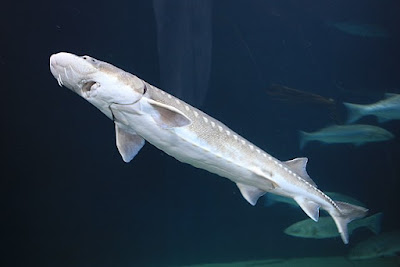
Sturdy Sturgeon

A sturgeon's toothless, telescoping mouth sucks up clams, crabs and shrimp like a vacuum. Wikimedia Commons. 

White sturgeon have been cruising San Francisco Bay’s murky bottom for thousands of years, and the species has been around since before T-Rex. 

Scientists believe that the fish may live to be over 100 years old. For this article I asked the question: What is the life expectancy of white sturgeon in the San Francisco Bay?

Read "Sturdy Sturgeon" in Estuary News to learn more about this fascinating fish.


Sunday, February 6, 2022

Suisun City is No Island

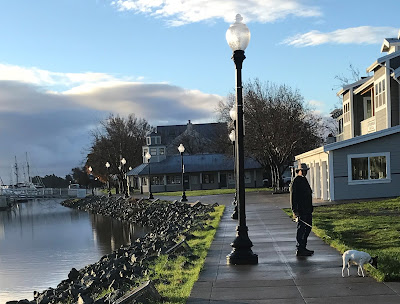
The daily waterfront walk

Suisun City, a small town about an hour northeast of San Francisco, has always had the waterfront and nearby wetlands at its heart. But that which is a big plus for trade and tourism now places the city in the path of sea-level rise.

In this article I delve into the challenges and opportunities of sea-level rise in my hometown.

"Suisun City is No Island," KneeDeep Times

The Magic of Winter Light


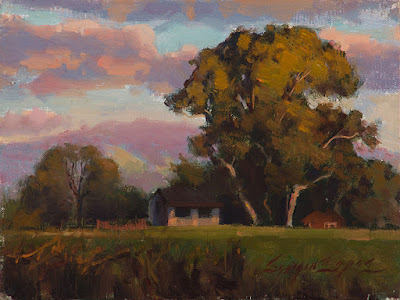
Turning In, Sergio Lopez

Winter light is less assertive than its summer counterpart. Hues are softer, and leafy shadows tat ephemeral quilts on the wall. More than a visual phenomenon, this subdued light affects all living things including poets, plants, and landscape painters.

"The Magic of Winter Light," Bay Area Monitor 

Tuesday, November 30, 2021

On the Bay: DFW 150 Years on Patrol, and Work Still Dangerous

Photo courtesy of the CDFW

This year marks the sesquicentennial of the California Department of Fish and Wildlife.

Patrolling the San Francisco Bay has always been dangerous work, and continues to be risky for those protecting the natural resources of the bay today.

"DFW 150 Years on Patrol and Work Still Dangerous,"

Estuary News

Thursday, October 28, 2021

Jack London's Wheel?

The Roamer wheel
Hugh and Jeremy Wire grew up in a house on a hill overlooking the ocean in Laguna Beach, California. In their yard was a wheel said to have come from one of Jack London’s boats.

I learned about the wheel from Hugh’s daughter, Annette Williams, who has inherited the house and the wheel.

Curious about whether or not the wheel actually did come from one of London’s boats, I asked her to send me a photo of the family wheel for comparison.

The family wheel
It seemed a straightforward investigation. Aside from the rowboat and centerboard skiff London skittered about on as a youth, he owned only four boats during his lifetime: the Razzle Dazzle, the Spray, the Snark, and the Roamer. We have photos of all but one wheel.

You can read about the wheel and the boat she came from in an essay I wrote for The Call, The Magazine of the Jack London Society (Spring/Summer 2021).